Monday, May 18, 2015
Timing is Everything!
I sense that most of my students hate to hear these dreaded words come from my mouth: "OK, let's try that with the metronome." And I get that--I never liked it either when MY teacher uttered those words!
But as a musician, having good timing when you play is one of the most important skills you can possess. You might be able to play a fast, melodic run of notes, but if you can't stay in time with other musicians or a director, then all of your amazing talent is simply going to go to waste.
The metronome is a very simple device that just makes a clicking sound at given time intervals, usually measured in bpm's (beats per minute). And they come in many different styles: from battery-powered electronic metronomes, to iPhone/iPad apps, to the antique metronome pictured above. There are even free metronome websites online!
Typically for beginning students, , metronome clicks are set to correspond with quarter notes--but there are some great exercises you can do with other note types to help improve you "internal clock," which I will demonstrate in the video below.
Another great exercise you can do sometimes is to simply lay your instrument aside, and just tap your foot along with the clicks of the metronome. This is a great way to also work on your "internal clock" so that when you do play with other musicians, you can tap your foot with the rhythm section, and stay in sync with the other musicians.
One final thought: when you're working on a musical piece, start the metronome off at a SLOW tempo, and gradually work your way up to playing the piece at a faster tempo. As I often say to my students, proper technique and good timing are MUCH more important than SPEED when you are learning an instrument.
So....timing really is everything. Please watch the video linked below for a demonstration of some ways to practice along with a metronome. Happy Pickin'!
Video Link--Timing is EVERYTHING
p.s I may have exceeded my 2-minutes on the video--but this is a SUPER-important topic!
Monday, May 11, 2015
Some Thoughts on the Bass Guitar
Since I don't want my bass guitar students to feel left out on this blog, I thought I might dedicate this post to them--and in the process, share some of my "philosophy" regarding the bass guitar.
But if you are a guitar "picker," you should really read this too, so that you understand your role compared to the bass player's role!
At it's very core, the bass player's main duty is to be the "glue" that helps to hold the bottom end of a song together. While the guitar players, keyboards, and vocals generally provide the melody and chord structures, the bass player is the one who provides the "anchor" and "bridge" between these melodic instruments, and the beat of the drums.
In many ways, I find it helpful sometimes to think of the bass guitar as a percussion instrument that you can play notes on.
A few more tips that I hope you will find helpful:
1) Take lessons, and dedicate part of each day to practicing your scales, lessons, and playing along with recordings. Relax, take a deep breath, and enjoy what you are doing.
2) Listen, listen, listen to what the drummer is doing on his kick, snare, and hi-hat--the two of you will really work together to set the pace, feel, and 'groove' of the song! In many songs, you will follow the same rhythm as the drummer's kick drum pattern.
3) Where possible, play with other musicians. I cannot overestimate the importance of spending time with other musicians who are learning as well. In the end, you will learn much from each other, and they will also help you to find your musical "voice."
4) Don't overplay! As mentioned above, the bass player and drummer provide the strong foundation upon which the rest of the musical house is built! Keep it simple, keep it solid!
5) Work with your teacher to learn chord structures, and the notes which make up chords. You can use this knowledge to play interesting passing notes between chords, and to form super-cool chord inversions that will really make your part stand out.
That is my "in a nutshell" philosophy of bass playing--but of course, there is much more to be covered in a future post. So in the meantime, keep up the good work, and be proud to provide a strong foundation that supports the entire song!
Watch the video below!
Thoughts and Tips for Bass Guitarists
Sunday, May 3, 2015
Suspended Chords--A Mystery No More!
From the Who's "Pinball Wizard" to Tom Petty's "Free Fallin" you have all heard suspended chords before, but may not have known how to form and play them on the guitar.
These chords are often notated as "sus" chords in guitar chord charts, but there really is no mystery--a suspended chord creates a harmonic "tension" by swapping out the 3rd of the key/chord for the 4th of a key/chord.
Knowing that all major and minor chords are built upon a 1-3-5 triad (major third for a major chord, and flatted third for a minor chord), you simply swap out a fourth for a third.
In the video link below, I demonstrate this with a D major chord, where I replace the F# on the first string with a G played on the first string with my pinky. The G is the fourth tone of the D major scale, and is the "suspension."
Of course, any major or minor chord can be suspended, but you do have to know a little bit about scales and chord structure. A good guitar teacher (such as myself--ha!) would be happy to show you how to do this easily in your head.
There is also an animal called the suspended 2nd, made most famous by Steely Dan, which I will cover in a future video.
But in the meantime, give these "sus 4's" a shot--the tension they create in the music is wonderful, and keeps a song really rolling forward!
Happy Pickin'!
Video On Suspended Chords
Monday, April 27, 2015
The Most Common Mistakes that Guitar Students Make
Over the years, I have found that there are some common mistakes that all guitar students make at some point or another. But these problems are easily fixed, once you can name what they are, and point them out with a sense of encouragement! And truth be told, this applies to all music students, regardless of what instrument they might be learning:
1) Failing to tune up before you play: Tuning your guitar is incredibly important, especially for beginning students. Not only do you want the songs you are learning to sound good--but as you learn, your brain is memorizing both where your fingers should be placed, as well as the notes you are playing. Trying to memorize these notes and sounds becomes much more difficult with an out-of-tune instrument.
2) Failing to pay attention to tempo and timing: Although most students do not enjoy playing along with a metronome, it is an extremely valuable tool to help build a sense of timing and rhythm. You can also use rhythm tracks, or a rhythm machine included with software like Garage Band. Or, simply tap your foot in a quarter note rhythm to help guide you through a musical piece. This sense of rhythm and timing is especially important if you ever plan to perform with other musicians!
3) Failing to have patience: Most students want to learn to play notes and chords as quickly as possible, forgetting that playing an instrument takes time, patience, and practice! You have to put the time in to get the results that you want. Or as one of my younger students says, "Practice makes perfect,and practice makes permanent." You will get where you want to be musically, but it does take time!
4) Failing to play for others: Many students are "shy" about playing in front of other people, especially if they're just starting out with lessons--but your friends, family, and other students are a great audience to have as you grow and learn your instrument. They're there to give you support and encouragement on your musical journey, so let them be there for you!
5) Falling prey to discouragement: Most often, we are our own harshest critics. When you get discouraged, remember what I said earlier--that in time, you will get where you want to be musically, if you are willing to put the time, energy, and discipline into learning and practicing. Every well-known and talented performer that you like to listen to started out exactly as you did--and probably made the same mistakes as you!
Click on the video link below to hear me talk a little more about these issues. Happy Pickin'!
Monday, April 20, 2015
Simple Strums for Beginners
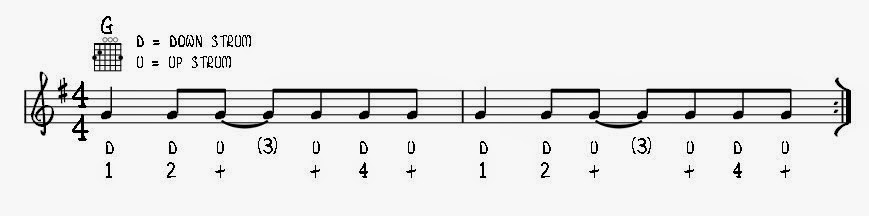
As a beginner guitar student, the most important things you are working on are probably learning your basic notes and how to read them, learning to finger common chords, and learning how to STRUM those chords in time.
Below are some images of common strum patterns that can be used in 4/4 time at almost any tempo (We'll deal with 3/4 and 6/8 time in a future post!).
On thing to remember is that strumming does not have to be fancy to be effective. This is especially true if you are accompanying yourself or someone else who is singing a tune. As you watch popular artists on TV or videos you will note that if they are singing, they're probably either doing a simple strum, or letting their second guitarist do the fancy stuff!
In any event, here are some common strums--and you'll note that in a lot of songs, it's sounds just fine to hit one strum per quarter note, or do two strums per beat in an eight-note pattern. While there are some "down" and "up" stroke indications for these strums, it's more a matter of what you are feeling and are capable of doing.
One last thing: I generally use a thinner pick for acoustic strumming, and I really try to use my whole are, bending at the elbow and letting my hand go across the strings in a smooth arc.
Click on the video link below for a demonstration of these strum patterns. Enjoy--and Happy Pickin'!
Monday, April 13, 2015
Developing Your Musical "Ear"
One of the best pieces of advice that one of my guitar teachers ever gave me was to always be working on developing my musical "ear"--that is, he encouraged me to work on 'hearing' notes in my head before actually playing them on my guitar.
This is a skill that takes some time to develop, but one that also pays HUGE dividends in the long run. Even if you are a beginner student, a good way to practice your lessons is to say or sing the names of the notes as you play them on your guitar's fretboard. Over time, you will see that you too will be able to hear those notes in your inner "musical ear," and it will become almost second nature to you.
And you don't have to be a great singer to do this training--in the privacy of your rehearsals and lessons, be intentional about this training. Eventually, you won't even have to sing the notes aloud, as your inner musical "ear" will be doing that silently inside of your head.
In the video link below, I demonstrate an easy technique for developing your ear. Happy Pickin'!
Monday, April 6, 2015
"Two-torial" #7--Cleanliness is next to Guitar Godliness!
Today's post and video are about the importance of keeping your guitar strings wiped down following every rehearsal, lesson, or performance session.
You may not realize it, but every time you play your guitar, your fingers leave behind traces of oil and perspiration which, along with the natural humidity in the air and airborne pollutants, begins to corrode your guitar strings.
Eventually the strings corrode, get "grungy," sound dull, and become way more likely to break!
By simply wiping down your strings and neck after every playing session, you will greatly extend the life of your strings,and they'll stay bright sounding.
As you can see in the video link below, any soft cloth will do; most music stores sell microfiber guitar cloths, but even a good old cotton T-shirt will work just fine.
Happy pickin' and cleanin'! The video link is below:
Keep Those Strings Clean!
Subscribe to:
Posts (Atom)